


Snap-8 Peptide: A Breakthrough in Anti-Aging?
Snap-8 (acetyl octapeptide-3) is a topical cosmetic peptide marketed as a gentler, non-invasive alternative to botox and “Botox-in-a-bottle” style approach to softening expression lines. This guide explains how Snap-8 actually works at the neuromuscular junction, how it differs from Argireline and from injectable botulinum toxin, how to use it in a routine, and what realistic results and safety look like.
Editorial & research disclaimer: This article is for educational and cosmetic-information purposes only and is not medical advice. Snap-8 is a topical cosmetic peptide ingredient; it is not a drug and is not a substitute for treatments such as botulinum toxin. Patch-test new products and consult a dermatologist for persistent skin concerns.

Quick Answer
What is Snap-8? Snap-8 is acetyl octapeptide-3, an eight-amino-acid topical peptide that mimics the N-terminal end of the SNAP-25 protein. By competing within the SNARE complex, it is proposed to modestly reduce the neurotransmitter release that drives repetitive facial muscle contraction — the contractions that etch expression lines over time.
Snap-8 is a cosmetic topical that works alongside collagen boosting ingredients that support collagen production, such as Matrixyl 3000 or GHK-Cu, not an injectable and not botulinum toxin. Results are subtle and gradual (weeks of consistent use), and it is best viewed as a maintenance ingredient rather than a wrinkle eraser.
Snap-8 = acetyl octapeptide-3, a topical peptide and an extended relative of Argireline (acetyl hexapeptide).
Mechanism: mimics SNAP-25 to compete in the SNARE complex, modestly reducing the signaling behind repetitive expression-line muscle movement.
Not Botox: topical peptides do not paralyze muscle; effects are subtle, gradual, and reversible.
Best for fine expression lines (forehead lines, frown lines, crow's feet) as part of a consistent routine.
Source carefully: concentration and formulation quality matter; verify ingredient grade and supplier transparency.
What Is Snap-8 and How Does It Work?
Snap-8 is the trade name for acetyl octapeptide-3, a synthetic peptide used as a topical cosmetic ingredient. It is an eight-amino-acid molecule that extends the design concept behind Argireline (acetyl hexapeptide-3/8), one of the best-known “neurocosmetic” peptides.
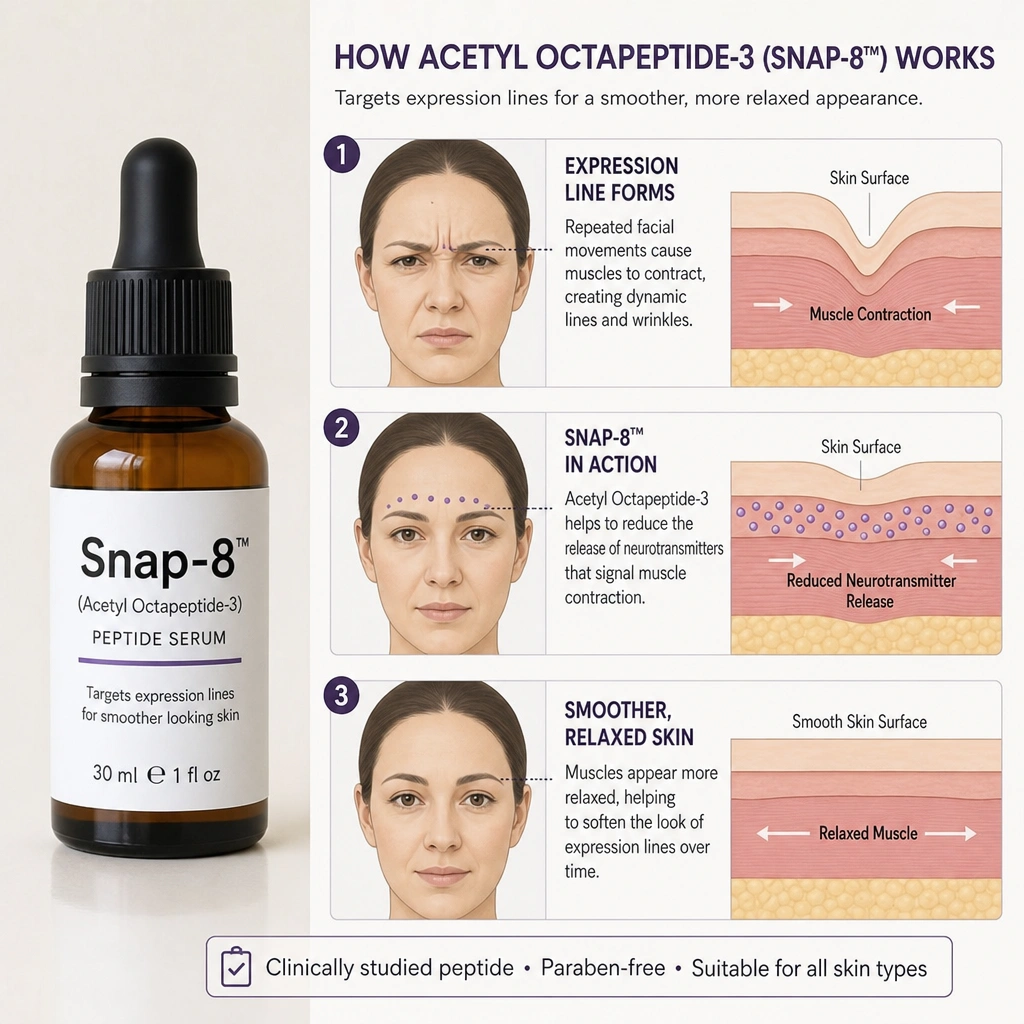
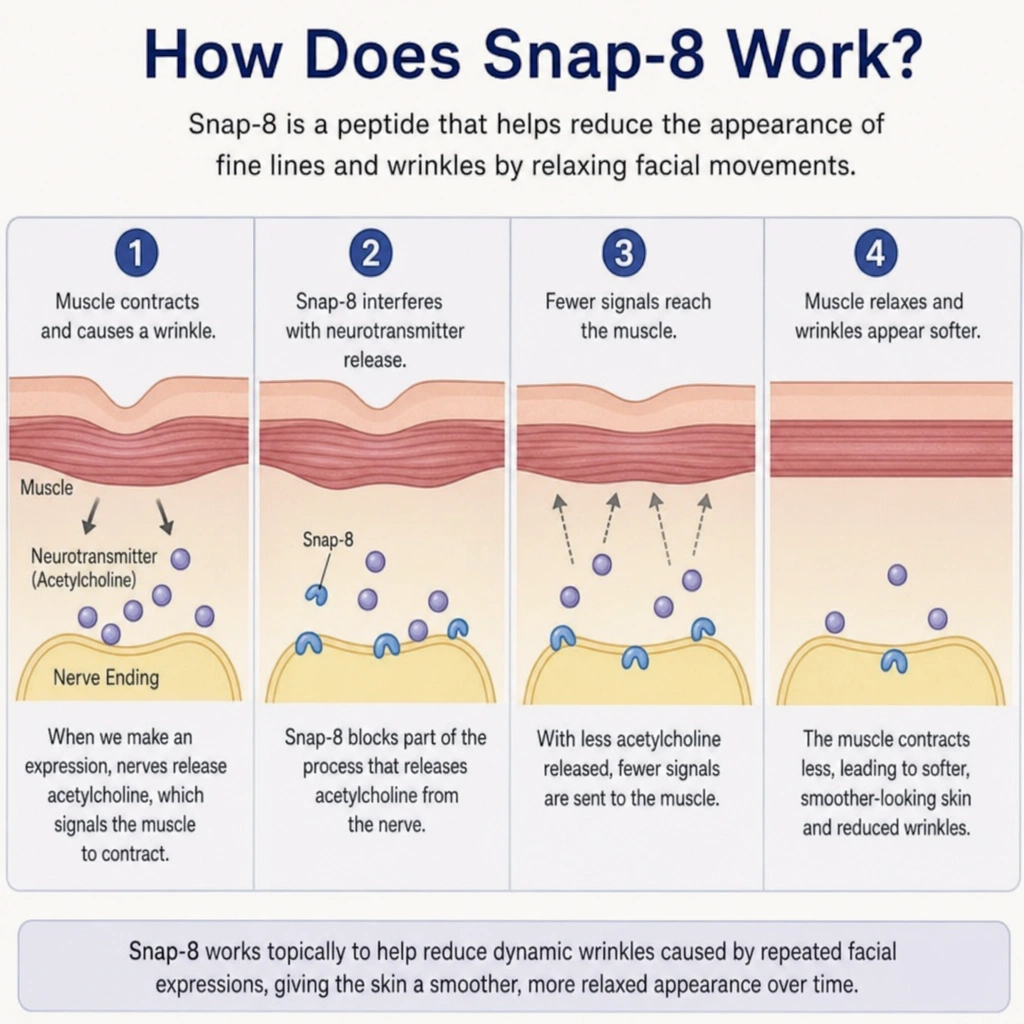
Facial expression lines form because muscles repeatedly contract when we frown, squint, and smile. That contraction depends on neurotransmitter release at the neuromuscular junction, which in turn relies on the SNARE complex (a group of proteins including SNAP-25). Snap-8 is designed to mimic the N-terminal segment of SNAP-25 and compete within that complex, modestly dampening the signal that triggers contraction.
The practical implication: with consistent topical use, muscles may contract slightly less forcefully, so dynamic expression lines and wrinkle depth can appear softer over time. The effect is subtle and temporary — nothing about a topical peptide paralyzes muscle the way an injection can.
Snap-8 vs Argireline vs Botox: What's the Difference?
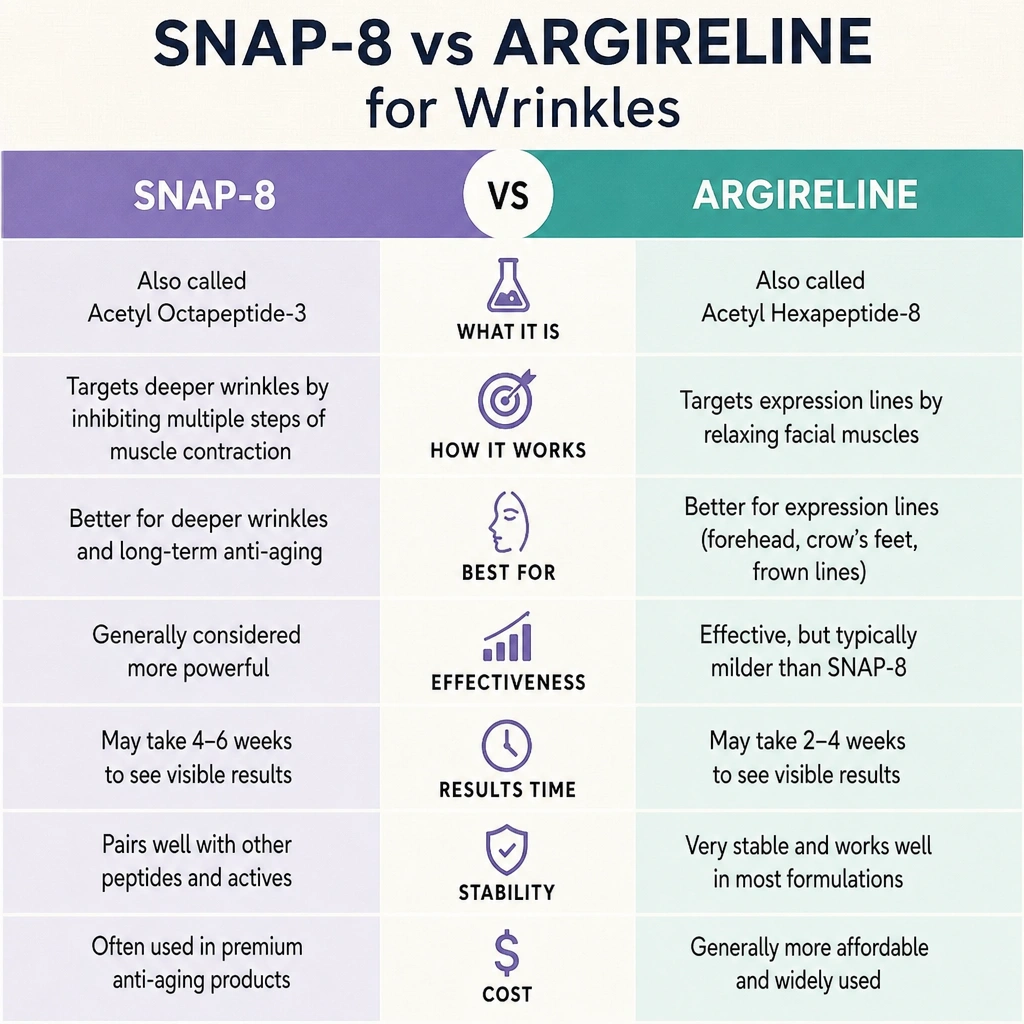
All three are discussed in the same “relax-the-muscle” category, but they are very different tools with different delivery, strength, and expectations.
| Factor | Snap-8 (Acetyl Octapeptide-3) | Argireline (Acetyl Hexapeptide) | Botulinum Toxin (Injectable) |
|---|---|---|---|
| Type | Topical cosmetic peptide | Topical cosmetic peptide | Prescription injectable drug |
| Delivery | Applied to skin | Applied to skin | Injected by a clinician |
| Strength of effect | Subtle, gradual | Subtle, gradual | Strong, clinically proven |
| Onset | Weeks of consistent use | Weeks of consistent use | Days |
| Reversibility | Fully reversible | Fully reversible | Wears off in ~3–4 months |
| Best for | Maintenance of fine lines | Maintenance of fine lines | Moderate-to-deep dynamic wrinkles |
Bottom line: Snap-8 and Argireline are complementary skincare ingredients for maintenance; botulinum toxin is a medical procedure. They are not interchangeable, and topical peptides will not replicate injectable results.
How to Use Snap-8 in Your Routine
Snap-8 is water-soluble and typically formulated into serums at modest percentages. To give it a fair chance to work:
- Cleanse and apply to dry skin before heavier creams or oils so the peptide is not blocked.
- Use consistently, twice daily — peptide effects depend on regular application, not a single use.
- Layer under a moisturizer to seal in hydration; peptides pair well with hyaluronic acid, niacinamide, or copper peptides like GHK-Cu.
- Always finish daytime routines with SPF — sun protection does more for visible aging than any peptide.
- Give it 8–12 weeks before judging results, and take consistent photos to track change objectively.
Injections vs. Topicals: Which Route for Snap-8?
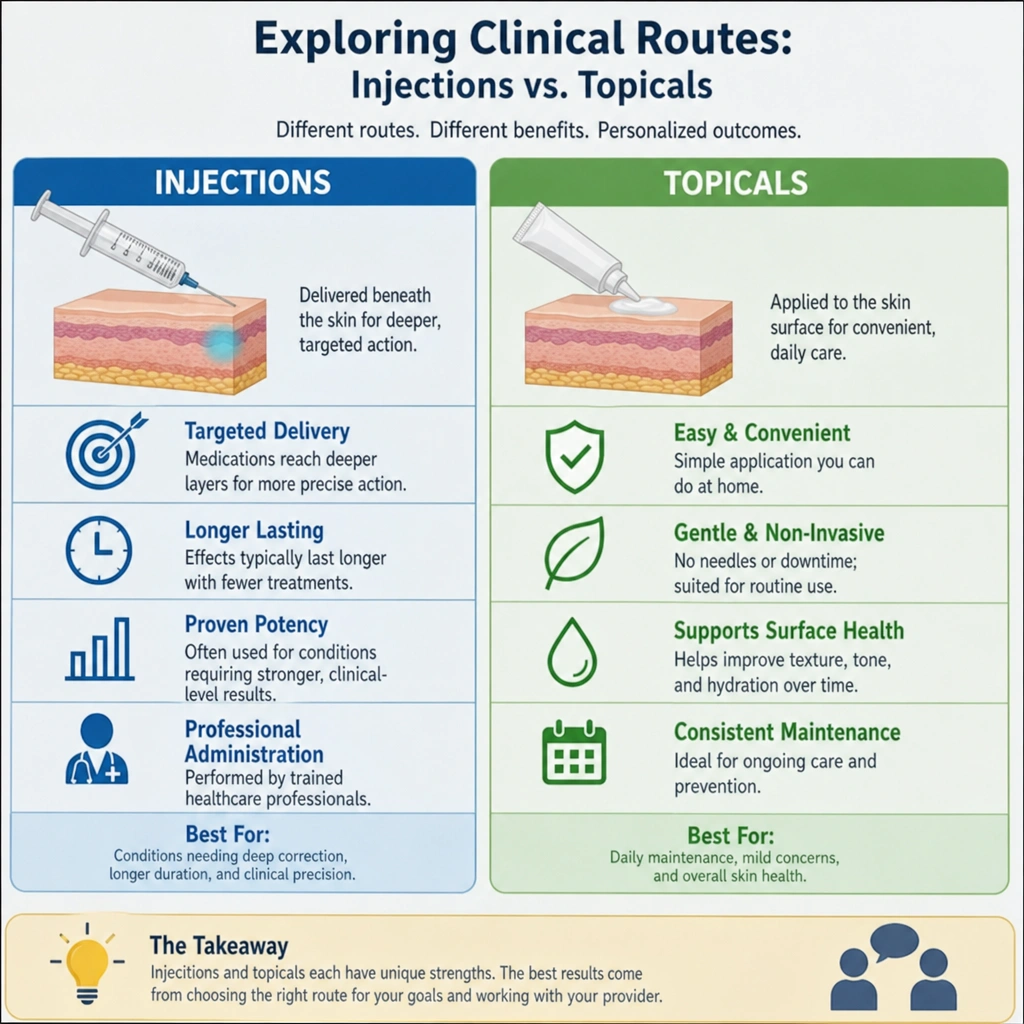
Snap-8 is designed and tested as a topical ingredient, and that is how it is used in cosmetics. While research peptides are sometimes discussed in injectable contexts, there is no established cosmetic case for injecting Snap-8, and doing so would fall outside its intended, evidence-supported use. For wrinkle relaxation by injection, the appropriate tool is a clinician-administered botulinum toxin product — not a cosmetic peptide.
Realistic Expectations and Long-Term Results
Set expectations at “softer skin texture, improved skin smoothness, and better-maintained skin,” not “wrinkles erased.” Topical peptides shine as part of a complete routine — cleanser, antioxidant, peptide serum, moisturizer, and daily SPF — and as ongoing maintenance between or instead of clinical procedures. Stop using it and any subtle benefit gradually fades, because the mechanism is reversible.
Safety Profile and Sourcing
Topical Snap-8 has a favorable cosmetic safety profile and is generally well tolerated, though any new product can cause irritation in sensitive users — so patch-test first. The bigger variable is product quality: concentration, formulation pH, stabilizers like caprylyl glycol, and ingredient purity determine whether a serum can actually deliver across the skin barrier.
- Check the concentration — effective serums disclose their acetyl octapeptide-3 percentage.
- Buy from transparent suppliers that publish ingredient sourcing and testing.
- Patch-test on the inner forearm before facial use.
- Pair with proven actives (retinoids, vitamin C, niacinamide, Matrixyl 3000, SPF) for meaningful anti-aging results.
Building a peptide-forward skincare routine?
Explore PrymaLab's research-grade peptide catalog and education hub to source and learn with confidence.
Explore PrymaLab Research PeptidesFrequently Asked Questions
What is Snap-8 peptide?
Snap-8 is the trade name for acetyl octapeptide-3, an eight-amino-acid topical cosmetic peptide. It mimics the N-terminal end of the SNAP-25 protein to modestly reduce the neurotransmitter signaling behind repetitive facial muscle contraction, which is what etches expression lines over time. It is a cosmetic ingredient, not a drug.
Is Snap-8 the same as Botox?
No. Botulinum toxin is a prescription injectable that strongly and temporarily blocks muscle contraction. Snap-8 is a topical peptide with a subtle, gradual, fully reversible effect that does not paralyze muscle. They are not interchangeable, and Snap-8 will not replicate injectable results.
How is Snap-8 different from Argireline?
Both are topical neurocosmetic peptides that target the SNARE complex. Argireline is acetyl hexapeptide (six amino acids); Snap-8 is acetyl octapeptide-3 (eight amino acids), an extended version designed for a similar but reformulated effect, often compared to Leuphasyl. In practice they are often used similarly and sometimes together.
How long does Snap-8 take to work?
Plan on 8–12 weeks of consistent twice-daily use before judging results. Peptide effects are cumulative and depend on regular application; a single use produces no lasting change. Tracking with consistent photos helps you evaluate subtle improvements objectively.
Can Snap-8 be injected?
Snap-8 is designed and tested as a topical cosmetic ingredient, and that is its evidence-supported use. There is no established cosmetic rationale for injecting it. For injectable wrinkle relaxation, the appropriate option is a clinician-administered botulinum toxin product, not a cosmetic peptide.
Is Snap-8 safe?
Topical Snap-8 has a favorable cosmetic safety profile and is generally well tolerated. As with any new skincare ingredient, sensitive users can experience irritation, so patch-test before facial use. Quality and concentration of the finished product matter more than the peptide alone.
What results can I realistically expect from Snap-8?
Expect softer, smoother-looking fine expression lines and lip lines, improved skin elasticity, and more youthful-looking skin that is better-maintained with consistent use — not the erasure of deep wrinkles. Snap-8 works best as part of a complete routine that includes antioxidants, a hydrating moisturizer, and daily SPF, which drive most visible anti-aging benefit.
Where should I buy Snap-8?
Choose suppliers that disclose the acetyl octapeptide-3 concentration, formulation details, and ingredient testing. Transparent sourcing and clear labeling are the main quality signals for cosmetic peptides. Verify the product is intended for its stated cosmetic use.
References & Further Reading
- Blanes-Mira, C., et al. (2002). A synthetic hexapeptide (Argireline) with antiwrinkle activity. International Journal of Cosmetic Science, 24(5), 303–310.
- Lim, S.H., et al. (2018). Cosmeceutical peptides and the skin: mechanisms and evidence. Cosmetics / dermatology review literature.
- Reddy, B., et al. Topical peptides in cosmetic dermatology (review).
- Manufacturer technical data on acetyl octapeptide-3 (SNAP-8) cosmetic ingredient specifications.
PrymaLab resources: Research peptides · Skin, hair & beauty peptides · Research Hub · FAQ · About PrymaLab.
Final disclaimer: This article is for educational and cosmetic-information purposes only. Snap-8 (acetyl octapeptide-3) is a topical cosmetic ingredient, not a drug, and statements about its effects have not been evaluated by the FDA. It is not a substitute for medical treatments such as botulinum toxin.
Patch-test new products, consult a dermatologist for persistent skin concerns, and verify the intended use and quality of any product before purchase. PrymaLab does not endorse any specific third-party vendor mentioned in this article.